Content
The Question Everyone Is Asking in 2026
You open a new browser tab and type: "do I need to learn SQL in 2026?" You are not alone. Millions of analysts, developers, and business professionals are asking the exact same thing — because AI tools can now take a plain English sentence and return a working SQL query in under three seconds.
It feels almost unfair. You spend weeks grinding through JOIN syntax and aggregate functions, and some AI tool does it in a single prompt. So what is the point?
The honest answer is: it depends on what you want to accomplish. But the more complete answer is that SQL knowledge and AI-generated SQL are not competing forces — they are a power combination. Let's break down why.
Why SQL Is Still Essential in 2026
Despite the rise of AI tools, SQL remains one of the most in-demand technical skills in the job market. Here is why it is not going anywhere.
Data Lives in Relational Databases
Whether you work at a startup or a Fortune 500 company, your data almost certainly lives in a relational database — PostgreSQL, MySQL, BigQuery, Snowflake, or similar. SQL is the native language of those systems. Every analyst, engineer, and data scientist interacts with these databases daily. Understanding SQL means you can speak that language fluently, not just copy-paste from a tool.
You Cannot Debug What You Do Not Understand
This is where most people hit a wall. An AI tool gives you a query. You run it. Something looks off — maybe the numbers do not add up, or the query is timing out on a large dataset. If you do not understand SQL, you cannot diagnose the problem. You are stuck waiting for another AI attempt, hoping it guesses better the second time.
Someone with even basic SQL knowledge can look at a generated query and immediately spot a missing WHERE clause, an incorrect GROUP BY, or a JOIN that is pulling duplicate rows. That ability to review and verify is irreplaceable.
Employers Still Expect It
Job postings for data analyst, business intelligence, product analyst, and backend developer roles almost universally list SQL as a required skill. The expectation is not that you memorize every function — it is that you can read, write, and reason about queries. AI tools have not changed that expectation yet.
How AI Tools Complement SQL Skills
Here is the part that often gets overlooked: AI SQL generators are not trying to replace SQL knowledge. They are trying to remove the friction of writing boilerplate queries from scratch, every single time.
Speed for Routine Tasks
Consider how much time an analyst spends writing variations of the same query. Pull total revenue by region. Now filter by last 30 days. Now exclude refunds. Now add a month-over-month comparison. Each of these is a small variation, but writing them manually adds up to hours per week.
An AI SQL generator handles these routine queries instantly. You describe what you need in plain English, and you get a working query. You review it, tweak if needed, and move on. The analyst's job becomes verification and interpretation — not syntax.
Lowering the Barrier for Non-Technical Teams
Marketing managers, product owners, and operations leads increasingly need data to do their jobs. They should not need to file a ticket and wait three days for a data analyst to run a report. AI-generated SQL — especially tools that connect directly to your database schema — allows these users to self-serve on simple queries while still having technical oversight available for complex ones.
A Learning Accelerator
Counterintuitively, AI SQL tools can actually help you learn SQL faster. When you describe a query in plain English and see the SQL output, you start to internalize patterns. You see how a LEFT JOIN is structured. You notice when a subquery is used versus a CTE. Over dozens of iterations, you build mental models that stick better than rote memorization from a textbook.
Tools like AI2SQL are built exactly for this workflow. You connect your database schema, describe what you need, and get a query tailored to your actual tables and columns — not a generic example. It bridges the gap between thinking in business logic and writing in SQL syntax.
When AI-Generated SQL Falls Short
Let's be direct: AI tools are not perfect, and blindly trusting generated SQL can cause real problems.
Complex Business Logic
Suppose you need a query that calculates customer lifetime value using a custom attribution model your company defined three years ago. The AI has no idea what that model is. You would need to explain it in extreme detail — at which point, writing the query yourself might be faster. Complex, context-dependent logic still requires human expertise.
Performance at Scale
A query that works fine on 10,000 rows can destroy performance on 100 million rows. AI tools do not always generate performance-optimized SQL. They might miss an index hint, use a correlated subquery where a JOIN would be faster, or return a result set that is far larger than needed. Understanding execution plans and query optimization is still a human skill.
Security and Data Access
AI tools generate queries — they do not manage permissions. If someone prompts an AI to pull customer PII from a database they should not have access to, the AI will try to write that query. Governance, role-based access, and data security are entirely separate concerns that require human judgment and proper database configuration.
Ambiguous Prompts Return Ambiguous Results
Garbage in, garbage out. If your English description of the query is vague or imprecise, the generated SQL will reflect that imprecision. "Show me the top customers" — top by what? Revenue? Number of orders? Most recent purchase? A tool cannot read your mind. You need to know enough SQL to evaluate whether the output actually answers your question.
The Best Approach: SQL Knowledge Plus AI Tools
The analysts and engineers winning right now are not the ones who know the most SQL trivia — and they are not the ones who blindly copy-paste from AI tools either. They are the ones who use both strategically.
Learn the Fundamentals, Not Memorization
You do not need to memorize every window function or know the exact syntax for every database flavor. You do need to understand:
How SELECT, FROM, WHERE, GROUP BY, and HAVING work together
The difference between INNER, LEFT, RIGHT, and FULL JOINs
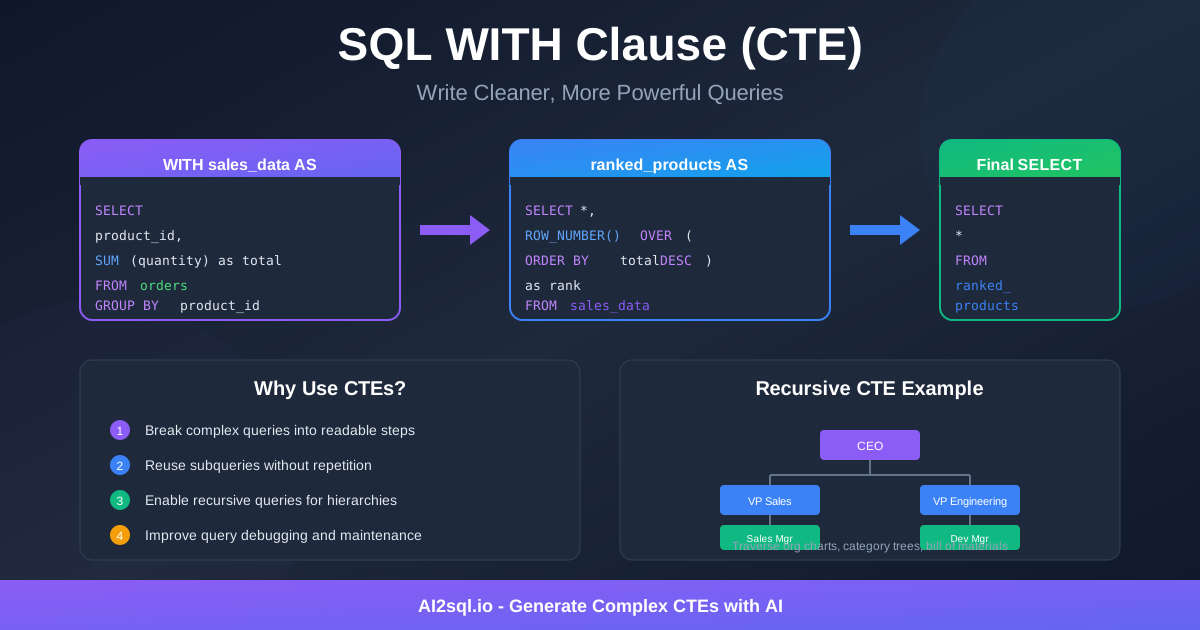
When to use subqueries versus CTEs
Basic aggregation: COUNT, SUM, AVG, MIN, MAX
How indexes affect query performance
With these fundamentals, you can review any AI-generated query and know whether it is doing what you think it is doing.
Use AI for the First Draft
Think of an AI SQL generator as a first-draft machine. You describe the query, it produces SQL, you review and refine. This workflow cuts the time to a working query by 60 to 80 percent. The human judgment step — checking the logic, verifying the output, optimizing for your specific schema — is where your SQL knowledge earns its value.
Connect AI Directly to Your Schema
Generic AI tools produce generic SQL. The real productivity unlock comes when the tool knows your actual database structure. AI2SQL connects directly to your database schema, which means generated queries reference your real table names, column names, and relationships. No more manually translating a generic example into your actual schema. The output is ready to run against your data.
This is the difference between an AI tool that saves you a few minutes and one that genuinely changes how fast you can work.
Conclusion: Learn SQL AND Use AI
The question is not "why learn SQL when AI can write it?" — it is "how do I use both to become unstoppable?"
SQL fundamentals give you the ability to think clearly about data, verify generated queries, debug problems, and handle complex logic. AI SQL tools give you speed, accessibility, and the ability to handle routine queries without friction. Together, they make you dramatically more productive than either approach alone.
In 2026, the analysts who thrive are fluent in both. They know enough SQL to be dangerous, and they use tools like AI2SQL to move faster than anyone who relies on just one or the other.
Start with the fundamentals. Then let AI handle the boilerplate. That is the combination that wins.